Cognitive apprenticeship/role of the trainer
From an active to a passive role. The role of the trainer gradually fades throughout the training course.
Our proven, method-based didactic framework, tested extensively, is designed to support your team’s training process. With Realists’ advanced technology and services, we enable the efficient transfer of knowledge and skills, ensuring the shortest possible learning curve for optimal results.
Discover the key pillars of our proven didactic framework for effective training and skill development.
From an active to a passive role. The role of the trainer gradually fades throughout the training course.
Orientation on the competence profile expected from a well-trained, independent and self-responsible surgeon. Learner-centred.
Real-world context
Briefing on patient case
Learning goals and tasks
S.O.P. (Standard Operating Procedures)
Debriefing, assessment, and feedback
Uses interactive scenarios to support active learning strategies such as problem-based learning. The learner must apply his knowledge, critical thinking and problem-solving skills in a safe but real-world context.
The CTA makes mental thinking processes, which are automated and not observable, visible to the learner and therefore helps to cope with tasks, solve problems, and to make decisions.
Based on our didactic framework, the recommended training process is supported by Realists’ products and technology to ensure effective learning and skill development.

Online preparation tool

The Realists Instructor explains the educational concept and use of the training system to the trainer.

The Realists Instructor explains to the trainees the Realists training concept.

Trainer introduces the “RealSpine Patient” who will be treated during the training course.
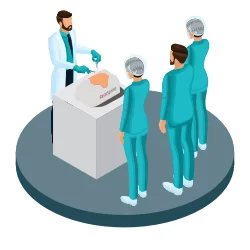
The trainer operates one Realists module and shows all participants the surgical procedure.

Under the supervision of a trainer, the trainees operate a Realists module.

The trainer gives feedback on the performance of the trainees.